Project
Internal CRO intelligence system
Year
2026
Role
Tools
Codex (Python, SQLite, Plausible API, Asana API, Triple Whale API)
Building a CRO Intelligence Agent to unify data, decisions, and business impact

From fragmented data to structured decision-making
As CRO efforts scaled at Purovitalis, insights became increasingly fragmented across analytics tools, task management systems, and revenue platforms. While data was abundant, it lacked structure, context, and direct connection to decision-making. This project focused on designing a CRO intelligence agent — a system that consolidates behavioral data, experiment history, and business metrics into a single layer to support faster, higher-quality decisions.
Problem
Business
CRO insights spread across multiple tools
No clear link between experiments and revenue impact
Slow, reactive decision-making
Operational
Manual weekly reporting
Experiment learnings not reused
Limited visibility into performance across teams
Impact
Slower iteration cycles
Missed optimization opportunities
Low confidence in prioritization
Analysis / Approach
Key insight
CRO doesn’t fail from lack of data — it fails from lack of connected context
Research highlights
Team relied on siloed tools (analytics vs tasks vs revenue)
Reporting focused on metrics, not decisions
Experiment knowledge was not systematically captured
Strategy
Shift from dashboards to decision-support systems through:
Centralizing fragmented data
Structuring experiment memory
Connecting UX work to business impact
Automating reporting, not decisions
Solution
1. Unified CRO dataset
The system was built around a single, centralized dataset that replaces fragmented sources of truth. By structuring analytics, experiment data, and revenue metrics into one layer, it creates a shared context for decision-making and removes the need to piece together insights across tools.
2. Multi-source integration
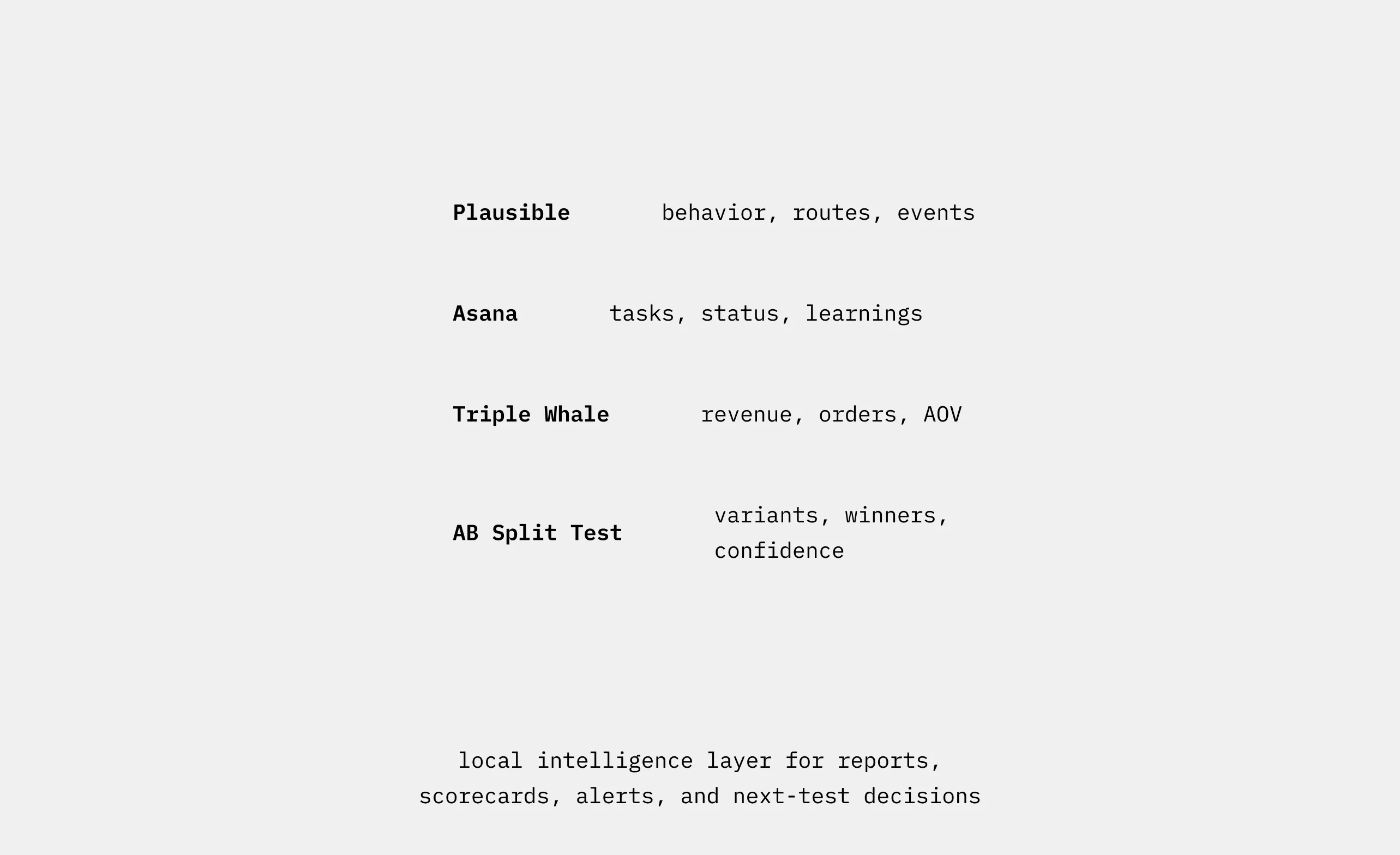
Instead of introducing another tool, the agent connects existing ones. Behavioral data from Plausible, workflow context from Asana, and revenue metrics from Triple Whale are unified, allowing performance to be evaluated in relation to both user behavior and business impact.
3. Structured experiment memory
To avoid repeated mistakes and lost insights, the system introduces persistent experiment memory. Tests are mapped to specific pages and outcomes, creating a growing knowledge base that informs future decisions and strengthens iteration over time.
4. Automated reporting layer
Manual reporting is replaced with structured outputs that highlight what changed and what requires attention. Weekly CRO reports, business-impact summaries, and bounce tracking shift the focus from raw data to clear, actionable signals.
5. Designer impact scorecards
Design decisions are directly connected to measurable outcomes through dedicated scorecards. By linking changes to performance, this feature makes the impact of design visible and positions it as a strategic contributor to business results.
6. Workflow integration (Asana)
Insights are fed back into the workflow through automated updates inside Asana. This ensures that relevant signals are visible at the point of decision-making, reducing manual communication and keeping teams aligned.
Results
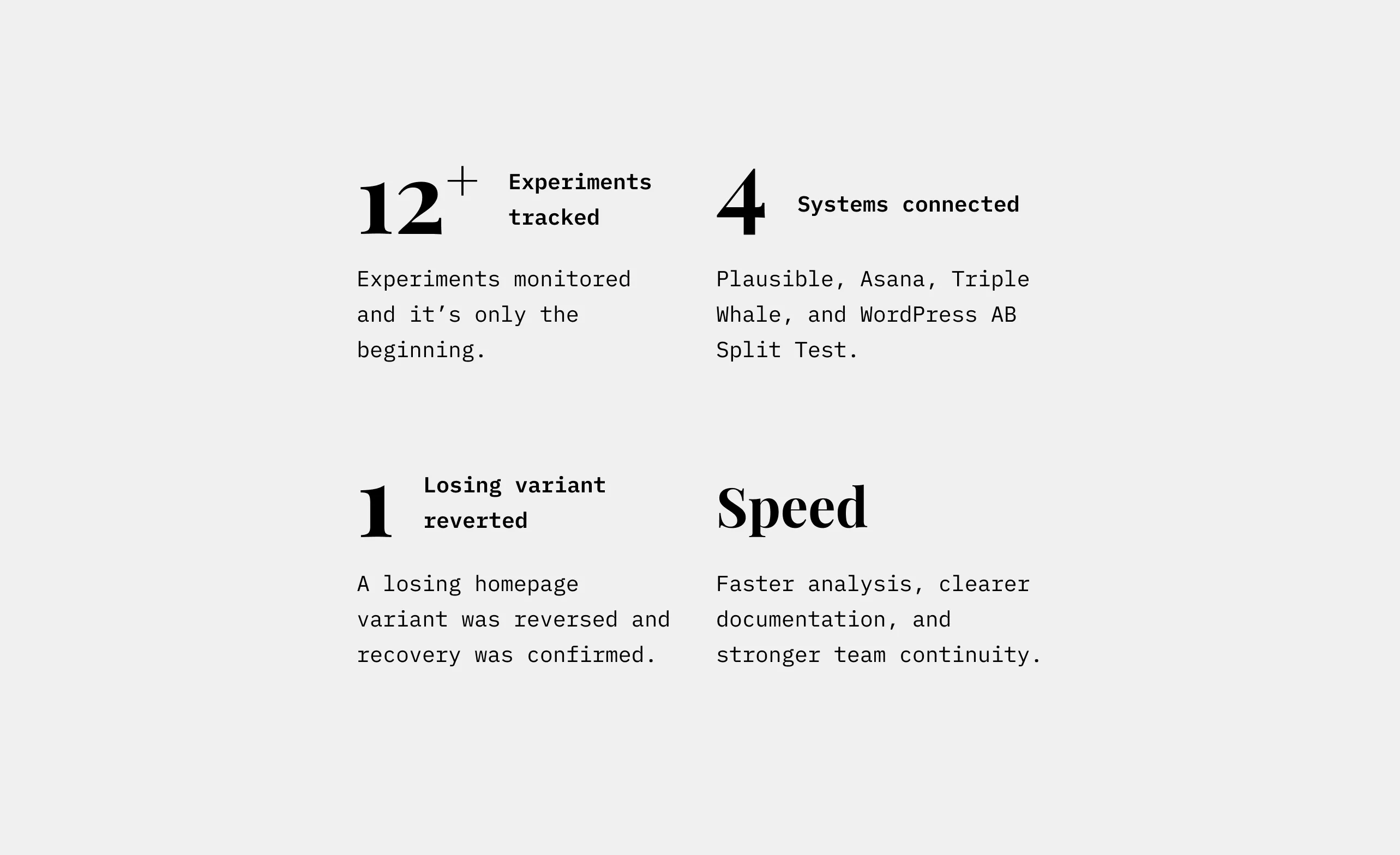
Reduction in reporting time
Faster CRO iteration cycles
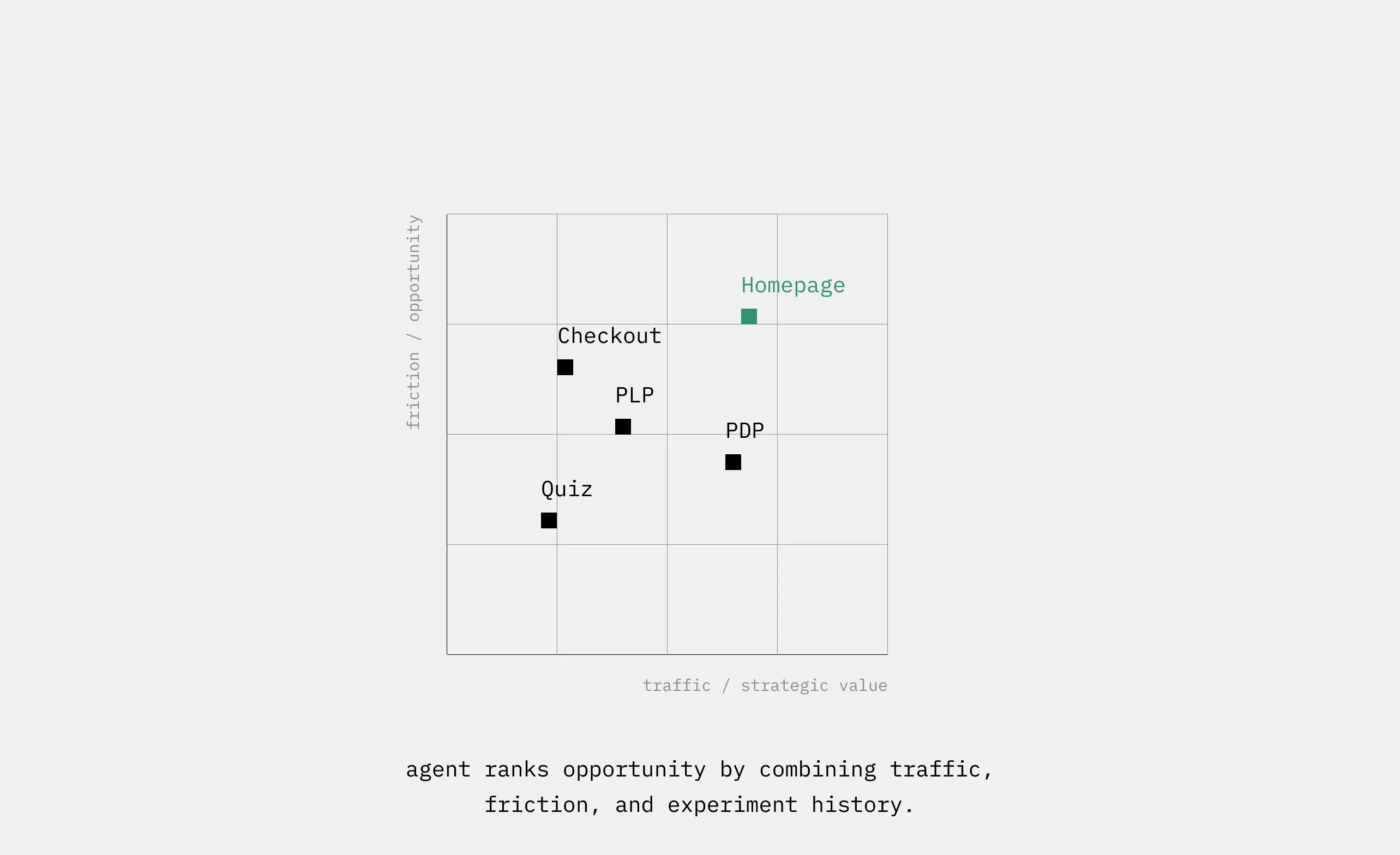
Improved prioritization of high-impact pages
Qualitative impact
Stronger alignment between design and business
Increased confidence in decision-making
Clearer understanding of what drives performance


Final reflection
Building the CRO agent shifted the role of design from interface creation to system design. Instead of focusing on individual experiments, the project created a structure that continuously improves how decisions are made. By connecting data, workflows, and outcomes, the system transformed CRO from a collection of tasks into a scalable, insight-driven process.
CRO strategy, UX systems thinking, data visualization, e-commerce optimization, experiment analysis, workflow design, design impact reporting
Next project
E-commerce PDP redesign
to the next project